Black Friday scams: fake shops, fake parcels and fake buyers
Black Friday is 27 November and Cyber Monday is 30 November. Here’s how the fake shops, delivery texts and marketplace tricks work, and how to check before you pay.
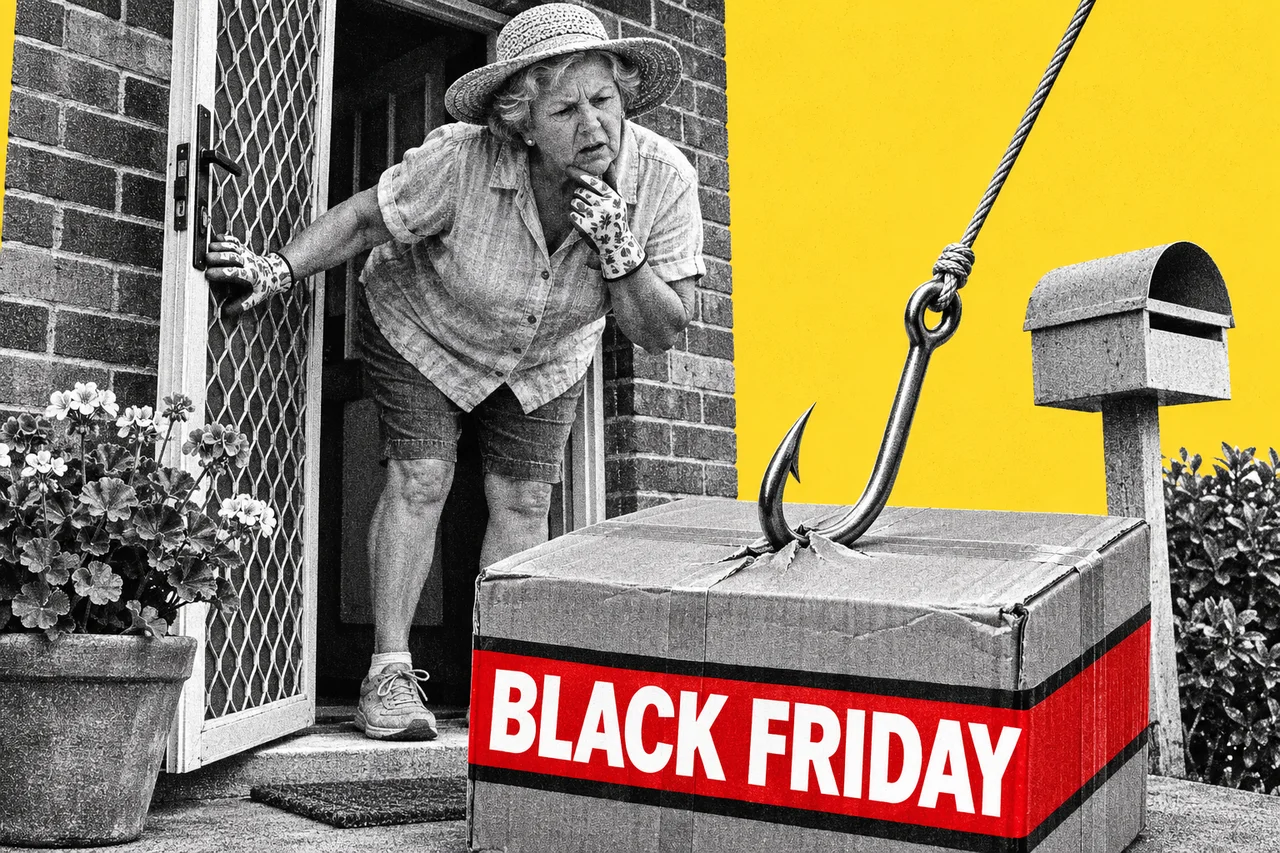
Black Friday lands on Friday 27 November this year, and Cyber Monday on 30 November. The bargains are real enough. So are the fake shops built to look like them.
The National Anti-Scam Centre says shoppers should be “especially alert to fake online shopfronts” as Black Friday and the holiday sales approach. Buying and selling scams made up 58.7% of Scamwatch reports involving a financial loss in the first nine months of 2026. More than 11,500 people reported losing a combined $17.2 million to them. We covered those figures in our story on shopping scams.
Here’s what the main tricks look like this sales week, and the checks that catch them.
The shop that only exists until you pay
A fake shop looks like a real one. Scammers build cloned stores and fake social media shops, according to Scamwatch. Some copy real business names and logos behind polished, AI-generated storefronts.
The National Anti-Scam Centre is blunt about it: “A familiar logo or polished, AI-generated online shopfront is not proof that a business is genuine.” Even an ABN can be part of the disguise. Fake car-sales sites it describes showed Australian addresses, phone numbers and ABNs.
Signs drawn from Scamwatch’s guidance and the centre’s examples:
- Prices that are unbelievably low, often with countdown timers, “limited time” offers and pressure to pay now.
- A shop that reached you through an unexpected ad or message. The centre advises going to retailers directly rather than through unsolicited messages or ads.
- A huge range of stock and promises of delivery anywhere in Australia, another feature of those sites.
- Missing basics: no terms and conditions, ABN or privacy policy, or links to them that don’t work.
- Odd payment requests: gift cards, crypto, money orders, pre-loaded cards, or several different PayIDs or accounts. The car-sales scammers sent professional-looking invoices asking for a bank transfer.
- A payee name that doesn’t match the shop.
- Reviews that are almost all glowing, or all posted within a short time.
- A web address with extra dashes or symbols, or one that imitates a real business.
Ads on your feed that are too good to be true
Many fake shops reach you through social media. Scamwatch says scam ads and profiles push items far below the usual price, sometimes with deepfake celebrity endorsements. Its rule of thumb: “If an offer appears too good to be true, it probably is.”
Before you buy from a shop you met on Instagram, Facebook or TikTok, check how long the account has been active, how many followers it has and how much it posts. Then look the business up separately, because a real logo proves nothing.
The parcel text you weren’t expecting
Sales week means lots of real deliveries, which gives fake delivery messages cover. Scamwatch says these texts claim there’s a “problem with your payment or your package delivery” and link to a scam site.
Australia Post’s scam alerts page lists the 2026 versions. There’s a redelivery fee text and a “verify your postcode” text. There’s an “attempted delivery” email and, from 17 November, a “confirm your address” email. It has also warned about fake postage-label websites.
Australia Post says it will never call, text or email you to ask for passwords, card details or a payment you weren’t expecting. If a message says a parcel is stuck, check in the AusPost app or the courier’s own website. Don’t tap the link. Our Spot the scam on parcel texts walks through one example line by line.
Selling, not buying: the fake buyer
If you’re clearing things out to make room for new purchases, the scam comes the other way. The centre’s 3 November update describes messages telling marketplace sellers their item has sold. They’re asked to verify their account or follow a link to receive payment.
The link opens a fake page pretending to be the marketplace, a payment service or sometimes your bank. One seller lost $1,800 from their account this way. Other fake buyers want an expensive item without seeing it, or “accidentally” overpay and ask for the difference back.
Australia Post adds one more: it will never send you a social media message asking you to arrange a courier for a marketplace listing.
A few checks before you pay
Scamwatch suggests these checks for an unfamiliar shop:
- Type the address yourself. Go to the retailer’s site directly rather than through an ad, and read the web address carefully. Don’t assume the top search result is the real shop.
- Look up the ABN on the government’s ABN Lookup.
- Check when the website was registered with ICANN Lookup. For a .com.au address, auDA’s WHOIS shows which company registered it. A big store on a brand-new domain deserves a closer look.
- Search the shop’s name with “scam” or “review” and read what independent sites say.
Pay in a way you can undo
How you pay decides whether you can get your money back. Scamwatch suggests PayPal or a credit card, and warns that many payments are instant, so recovering money is unlikely. On a marketplace, it says to use the platform’s recommended payment method and keep the conversation on the platform.
The ACCC says that in some situations, a card provider “may reverse a charge” if you paid by credit card and the goods never arrived. Time limits may apply, so act quickly.
The ACCC is also watching the genuine retailers this week. Its third Black Friday and Cyber Monday sweep, announced on 10 November, looks across websites, emails and social media for the first time. Its targets include misleading “storewide” claims and “limited time” offers that carry on after the stated end. So are “was” prices the item was never, or not recently, sold at. Our guide to telling if a tech discount is real covers those checks.
If you’ve already paid
Move fast. Contact your bank or card provider straight away and change your passwords. Then report it to Scamwatch and to ReportCyber (reportcyber.gov.au). IDCARE (1800 595 160) helps if your personal details have been used. Forward suspicious Australia Post messages to scams@auspost.com.au.
Checklist
- Go to shops directly. Type the retailer’s web address yourself instead of tapping a sale ad or a link in a message.
- Look up the ABN. Check the shop’s ABN on the government’s ABN Lookup before you buy.
- Check when the website was registered. Use ICANN Lookup, and auDA’s WHOIS to see who registered a .com.au address.
- Search the shop’s name with “scam” or “review”. Read independent reviews, not just the ones on the shop’s own site.
- Pay by credit card or PayPal. Don’t pay by gift card or crypto, and check the payee name matches the shop before any PayID or bank transfer.
- Check parcels in the courier’s own app. Don’t tap links in delivery texts or emails; check in the AusPost app or on the courier’s own website.
- Keep marketplace sales on the platform. Never follow a link in a message saying your item has sold, and never refund a buyer’s overpayment.
- Call your bank straight away if you’ve been caught. Then change your passwords and report it to Scamwatch and ReportCyber.
Tick items as you go. Your ticks stay in this browser.